

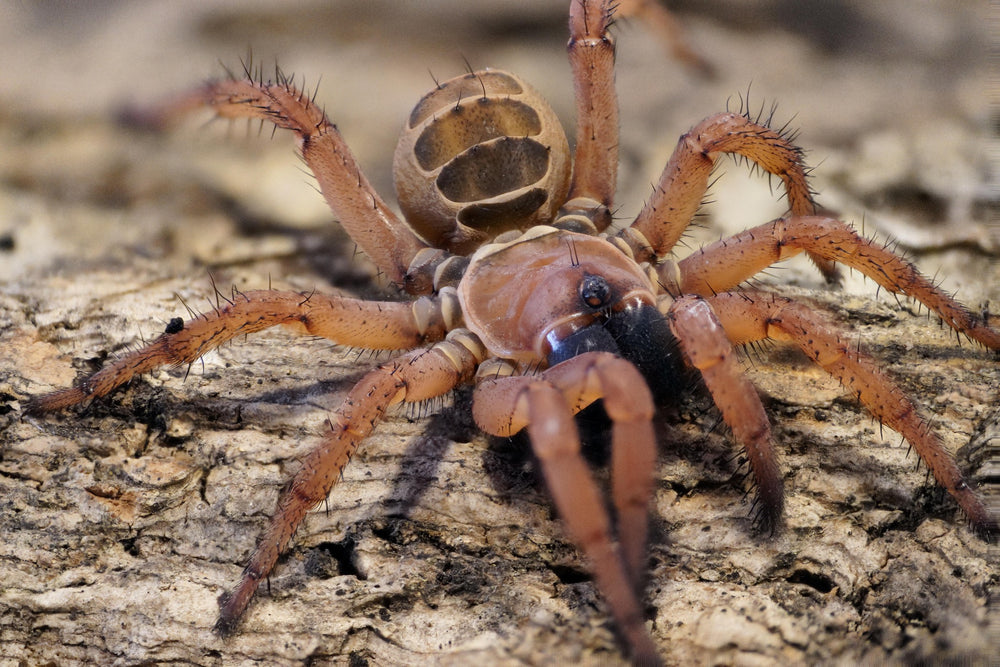
The Endangered Species Act and Poecilotheria

One of the more unusual legal restrictions affecting the tarantula hobby in the United States involves five species of Poecilotheria native to Sri Lanka.
Under the federal Endangered Species Act (ESA), these five species are classified as endangered:
-
Poecilotheria fasciata
-
Poecilotheria ornata
-
Poecilotheria smithi
-
Poecilotheria subfusca
-
Poecilotheria vittata
The U.S. Fish & Wildlife Service formally listed these five species as endangered in 2018, with the final rule becoming effective on August 30, 2018. The listing was based largely on concerns surrounding habitat loss and degradation in Sri Lanka, with the Service determining that these species were in danger of extinction throughout their ranges.
It is worth emphasizing that these are foreign species. The fact that they do not naturally occur in the United States does not prevent them from receiving protection under the ESA. The Act allows the U.S. Fish & Wildlife Service to list species whose entire natural range occurs outside the United States, and doing so places restrictions on certain activities involving those animals within U.S. jurisdiction.
What does this mean for the tarantula hobby?
The restrictions become particularly important when an ESA-listed Poecilotheria crosses state lines as part of a commercial transaction.
Section 9 of the Endangered Species Act prohibits, among other things, the sale or offer for sale of an endangered species in interstate or foreign commerce. It also prohibits delivering, receiving, carrying, transporting, or shipping a listed animal in interstate or foreign commerce in the course of commercial activity.
The ESA defines "commercial activity" broadly as activities involving industry and trade, including buying and selling commodities and activities intended to facilitate those transactions.
For a business such as Spider Shoppe, this creates a significant limitation. We cannot simply sell one of these species to a customer in another state and ship the animal to them. We also cannot circumvent the restriction by changing the terminology surrounding the transaction or by treating a commercial transfer as something other than a sale.
There are permitting mechanisms under the ESA that can authorize certain interstate commercial activities involving listed species. The U.S. Fish & Wildlife Service, for example, has a specific interstate-commerce permit process for endangered and threatened wildlife. These permits can authorize activities such as the transport or sale of listed species across state lines when the proposed activity meets the requirements of the Act.
However, simply being captive-bred does not automatically remove an animal from ESA protection. A captive-bred Poecilotheria is still an individual of an ESA-listed species.
What about gifts and loans?
This is where the law can become somewhat counterintuitive.
The ESA's interstate-commerce prohibition is specifically tied to commercial activity. As a result, genuinely noncommercial transfers—such as certain bona fide gifts or loans between private individuals—can be treated differently from a commercial sale. However, the distinction is important, and a transaction cannot simply be labeled a "gift" or "loan" when it is actually part of a commercial transaction.
For that reason, we do not use gifts, loans, trades, or other arrangements as a way to circumvent the restrictions applicable to our business.
What this means for Spider Shoppe
As a retail business, our responsibility is straightforward: we will comply with the Endangered Species Act and will not make exceptions to these restrictions.
If an ESA-listed Poecilotheria is legally available to us, that does not mean we can necessarily sell and ship it to a customer anywhere in the country. Interstate commercial transactions involving these species are subject to federal restrictions, and we will not attempt to work around those restrictions through alternative transaction methods.
This can be frustrating for keepers and breeders, particularly because these species have become established in captive collections within the United States. There is also an important conservation argument for maintaining healthy captive populations of endangered species. Captive breeding can preserve genetic material and reduce pressure on wild populations.
At the same time, conservation-minded intentions do not eliminate the requirements of federal law.
For Spider Shoppe, the answer is therefore simple: if federal law prohibits us from completing a transaction or transporting an animal across state lines, we will not do it.
We would rather turn down a sale than put our customers, our employees, or our business in a position where we are attempting to circumvent federal wildlife regulations.
The Endangered Species Act is a serious federal conservation law, and compliance is not optional. While we hope that regulations and permitting systems will continue to evolve alongside responsible captive breeding, until the law changes—or we obtain the appropriate authorization—we will operate within the restrictions currently in place.


